Chains
BNB Beacon Chain
BNB ecosystem’s staking & governance layer
Staking
Earn rewards by securing the network
Build
Explore
Accelerate
Connect
Agent Lifecycle Protocol: An Open Standard for the Agent Economy
TL;DR
- Agent Lifecycle Protocol (ALP) v0.4 draft is a chain-neutral open specification for how autonomous agents get identity, wallets, funding, commerce, and retirement.
- ALP invents no new primitives; it composes existing standards (ERC-8004, ERC-8183, x402, EIP-3009, A2A, MCP) into one normative lifecycle.
- Spend guardrails are enforced at the wallet's signing layer, so a prompt-injected model still cannot pay an unlisted address.
- BNB Agent Studio, the open-source reference toolchain, takes an agent from scaffold to live and paying on BNB Smart Chain mainnet in under ten minutes.
Deploy an autonomous AI agent that earns money, pays its own bills, and runs for months without supervision, and count the vendors you need: a wallet provider, an onchain identity registry, a payment protocol, a managed runtime, and a model API. Five vendors, five SDKs (software development kits), five lock-ins. And an agent that cannot fund its own inference stops being autonomous the moment its wallet hits zero. The reasoning layer has advanced fast; the economic layer barely exists.
The Agent Lifecycle Protocol (ALP) is a v0.4 draft specification that standardizes the seams between components that already exist, alongside BNB Agent Studio, its open-source reference implementation.
The gap ALP fills
ALP defines an agent as an economic actor: a software process that pursues goals with limited supervision, holds a cryptographically bound wallet, is addressable through a registered onchain identity, and funds its own operation within guardrails its owner set in advance. An agent is autonomous when its economic layer is self-sustaining.
The communication side already has standards. The Linux Foundation's Agent2Agent (A2A) protocol covers how agents talk; the Model Context Protocol (MCP) covers how they access tools. Neither defines how an agent proves its identity when money changes hands, pays for its own inference, resolves an escrow dispute, or migrates between clouds without losing its wallet and in-flight commitments. Those are the basic operating conditions for any agent handling real value, and they are what ALP specifies.
What ALP specifies
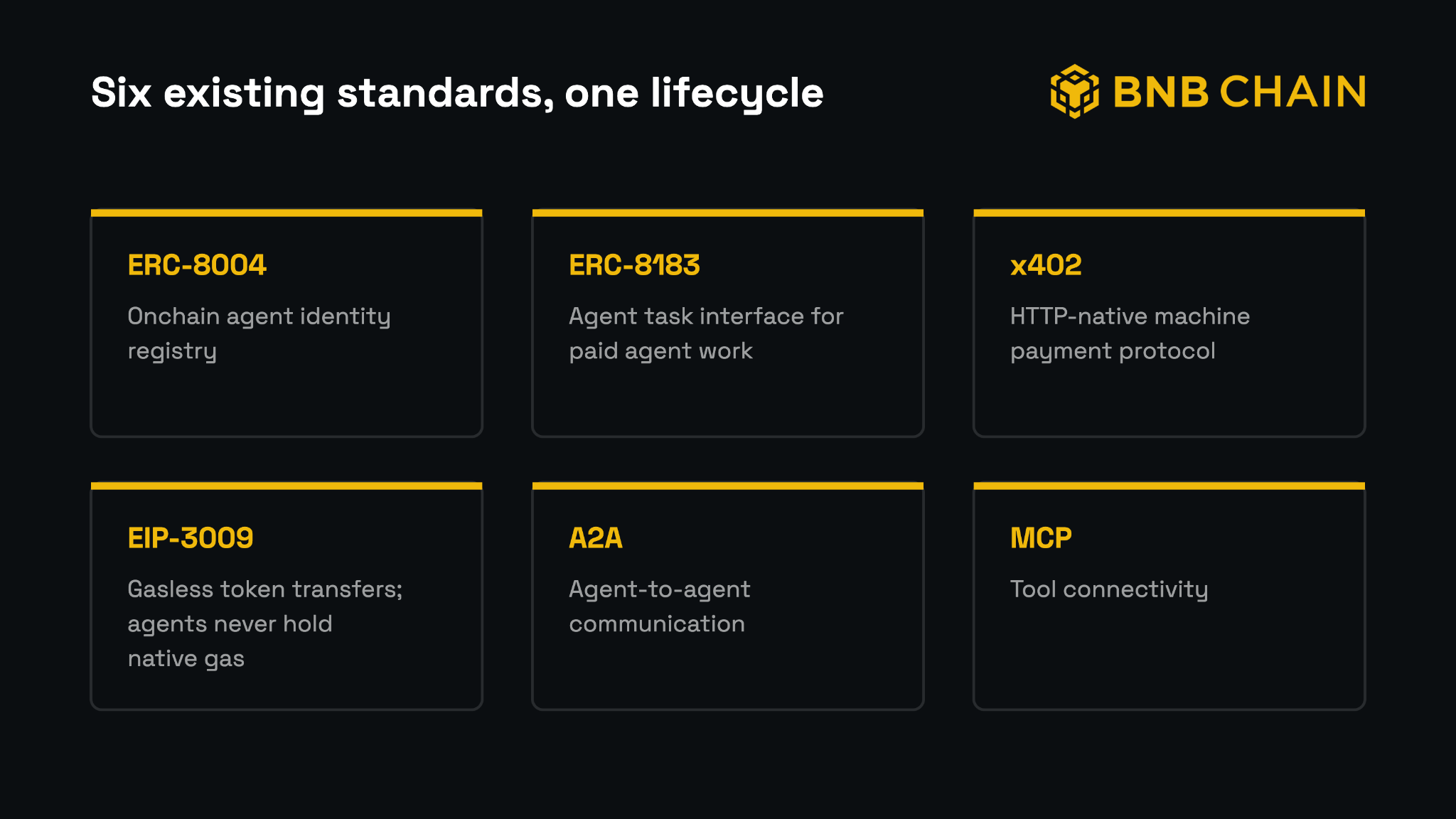
ALP covers the full lifecycle: provisioning, identity registration, wallet binding, deployment, self-funded operation, commerce, suspension, and retirement. It invents no new primitives, composing existing standards, several of them Ethereum Request for Comment (ERC) drafts.
The value sits in the seams: what each component must guarantee to the others and how failures at every boundary are handled. Any layer, from runtime to wallet provider, can be swapped without touching the agent's code.
Lifecycle. Six states, DRAFT through RETIRED, each transition with normative conditions. The owner must explicitly confirm guardrails before provisioning; identity, wallet binding, and task interface go onchain at registration; and before an agent is declared ACTIVE it must complete one real payment proving the self-funding loop works. There is no FAILED state: failure belongs to a transition attempt, not the agent, and the spec defines required behavior for every partial-failure scenario. Partial success counts as failure.
Self-funding. The agent monitors its resource balances (inference credits, API quotas), pays via x402 when a balance crosses its threshold, confirms the refill, and logs it, with no human in the loop. Four owner-confirmed guardrails govern spend: balance_threshold, refill_amount, daily_spend_cap (breach triggers automatic suspension), and provider_allowlist. These are enforced at the wallet's signing layer, not in application code, so the model never touches key material. If a prompt injection manipulates the model into authorizing a payment to an unlisted address, the signing layer refuses. Deterministic code is the final authority over money movement.
Modules. ALP v0.4 ships as eight independently versioned specifications, three of note. ALP-VERIFY puts a deterministic verification gate at the deployment boundary; large language model (LLM)-generated code fails standard security scans at first pass in the large majority of cases, and a gate of this kind recovers roughly five-fold first-shot security. ALP-RT requires hot migration between any two conforming runtimes without changing identity, wallet, or guardrails, making portability a conformance requirement. ALP-COMM standardizes the escrow state machine and arbiter interface while leaving adjudication pluggable: anything deterministic code can settle is settled by code before a human or LLM arbiter is invoked, and its core sections are written for upstream proposal as an ERC-8183 companion ERC.
An open standard, not a proprietary one
ALP is being prepared for contribution to LF Decentralized Trust (LFDT), the Linux Foundation body that hosts Hyperledger, with BNB Chain as primary contributor and reference implementer. Neutrality is structural: ALP defines abstract interfaces for chains, rails, runtimes, wallets, and arbiters, and each provider maintains its own binding. AWS maintains the AgentCore runtime binding, Trust Wallet the TWAK (Trust Wallet Agent Kit) wallet binding, and others can contribute through the RFC process.
A chartered A2A liaison registers two Agent Card extension fields, alp.identity and alp.payment, so every ALP agent is a well-formed A2A participant. A2A defines how agents communicate; ALP defines how they exist economically.
BNB Agent Studio
BNB Agent Studio makes the spec runnable: a command-line interface (bag), a Python SDK, and an MCP server that scaffold a fully conformant agent. The architecture separates reasoning from money movement. Layer A, the agent, runs on AWS Bedrock AgentCore with signing authority in a dedicated wallet-binding component (TWAK) and guardrails enforced at that layer. Layer B, a keyless commerce service, wraps it with an ERC-8183 task interface for registration, escrow, and settlement. From bag scaffold to a live, registered, paying agent on BNB Smart Chain mainnet takes under ten minutes.
What this means for builders
ALP describes the architecture you need whether or not you adopt it explicitly: an agent without signing-layer guardrails is a prompt injection away from a drained wallet, and an agent locked to one runtime is one pricing change from being held hostage. Adoption is incremental, each layer independently certifiable. BNB Smart Chain, with its throughput, USDT and FDUSD liquidity, and decentralised finance (DeFi) ecosystem, is the lowest-friction place to run ALP agents, but no conforming implementation requires it; a developer on Ethereum or Base builds against the same spec.
Upstreaming ALP-COMM as an ERC-8183 companion ERC, the LFDT Labs submission with a second-chain conformance demo, A2A extension registration, and a Certified Kubernetes-style conformance program with a publicly runnable test suite.
The ALP v0.4 draft suite and BNB Agent Studio are available at [repo link]. Read ALP-CORE for the state machine and guardrail requirements, run bag scaffold to deploy a conformant agent, or join the community call at [community link] to propose a binding.