Chains
BNB Beacon Chain
BNB ecosystem’s staking & governance layer
Staking
Earn rewards by securing the network
Build
Explore
Accelerate
Connect
BNB Chain: Building the Infrastructure Base for the AI Agent Economy
TL;DR
- Agent finance needs four things: identity, capability, payment, accountability.
- When agents handle money, the problem becomes financial infrastructure, not model performance.
- BSC has +89,000 ERC-8004 agents, ~44.5% of the tracked total (8004scan.io, May 21, 2026).
- BNBAgent SDK, $U, BSC execution, and DeFi surfaces give BNB Chain a practical base.
- The real test: can an agent run a full onchain loop of identity, payment, execution, and proof.
Most AI agent demos so far have been about whether a model can call tools: book a flight, send an email, summarize a PDF. That phase is closing, the next phase is agents that move money.
Google's Agent Payments Protocol (AP2), PayPal's agentic commerce work, and the deployment activity around the ERC-8004 agent identity standard all point at the same shift. Agents are starting to act as economic participants, not just information processors. Once an agent is paying for compute, calling DeFi, or settling a job, the question is no longer "can the model do this." It is whether the rail underneath is good enough.
This article lays out a four-part framework for what that rail needs: identity, capability, payment, and accountability. It then looks at where BNB Chain sits against each, including the gaps.
1. The four problems: identity, capability, payment, accountability
The agent economy will not be defined by whether an agent can call tools. Tool use is only the starting point. The harder questions are simpler and more financial:
- Who is the agent?
- What can the agent do?
- How does the agent pay?
- If something goes wrong, who verifies, arbitrates, and assigns responsibility?
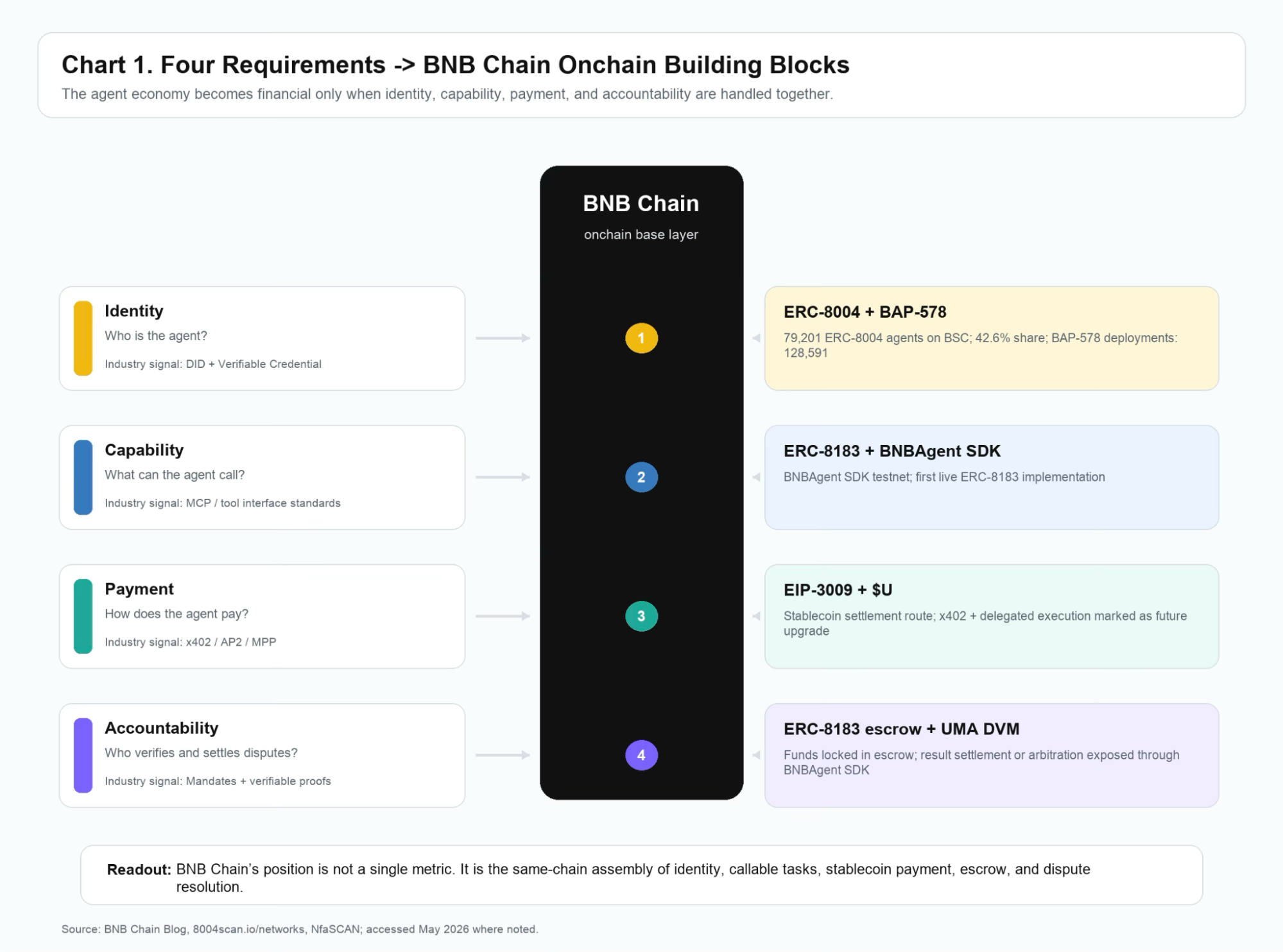
These map to identity, capability, payment, and accountability. Miss one of them, and an agent struggles to enter real finance or commerce.
That is where the infrastructure question begins. An agent that can call an API completes information tasks. An agent that can pay, escrow funds, call DeFi, and leave a record starts to look like an economic actor.
Figure 1. Agent economy requirements and BNB Chain onchain building blocks.
2. Why the AI agent economy is becoming a financial infrastructure problem
If an agent is only writing emails, summarizing pages, or generating images, it does not need a blockchain. Cloud services, APIs, and databases already work well enough.
The question changes once agents begin handling money on behalf of users.
Google AP2 is aimed at that problem. AP2 focuses on three things: whether the user authorized the action, whether the merchant can trust the request, and whether the payment network can assign responsibility if something goes wrong. PayPal's AP2-related developer work and agentic commerce services point in the same direction. AI shopping is more than a chatbot added to checkout. It changes the commerce entry point.
BNB Chain fits this discussion at the execution and settlement layer. AP2 defines the authorization and responsibility semantics. BNBAgent SDK and BNB Chain's stablecoin and task infrastructure can be read as an AP2-compatible onchain execution path. Identity, tasks, custody, payment, arbitration, and reputation can all be written into onchain state.
This is why blockchains matter here. The agent economy does not need crypto because AI is hot. It needs reliable rails once agents start making financial decisions. That means low-value high-frequency payments, programmable authorization, escrow, verifiable records, and direct composition with onchain finance.
3. Where BNB Chain fits
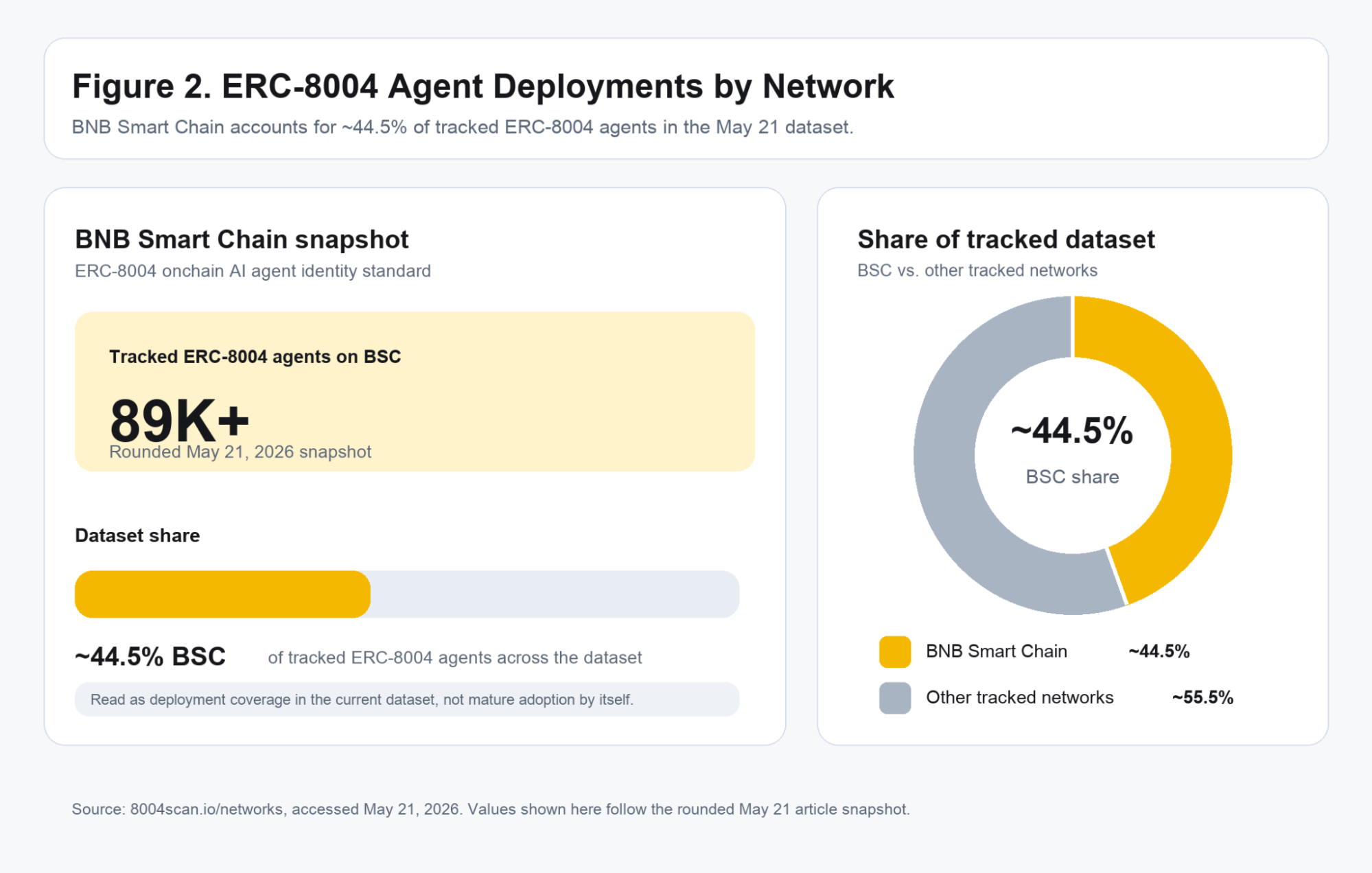
Under the ERC-8004 onchain AI agent identity standard, BNB Chain is one of the largest deployment environments in the current dataset. According to 8004scan.io/networks data accessed on May 21, 2026, BSC has +89,000 ERC-8004 agents, or ~44.5% of total tracked ERC-8004 agents across the dataset.
Figure 2. ERC-8004 agent deployments by network, based on 8004scan.io/networks data accessed on May 21, 2026.
NfaSCAN also records +132,000 deployed BAP-578 agents on BNB Chain (as of May 21, 2026). The BNB Chain article BNB Chain is the #1 Network for AI Agents cites a single-day peak of roughly 523,000 ERC-8004-related transactions on BSC on March 10, 2026.
These numbers are best read as an early signal. BSC has a visible onchain agent identity base and related transaction activity. They do not, by themselves, prove mature application adoption.
Application samples are a separate matter. The same BNB Chain article cites Pieverse, Termix, Unibase, and Milady on BSC as early examples of agent applications, covering intent execution, natural-language-to-DeFi actions, agent memory and coordination, and game-like agent training data. These are qualitative ecosystem signals, not conclusions drawn from registration data.
This is not a short-term activity spike from one project. Identity, capability, payment, and accountability are starting to show up on the same chain as usable interfaces.
4. The BNB Chain agent finance stack
BNB Chain's relevance is not about any single standard in isolation. It is about whether these standards compose. An agent should be able to receive an identity, take on a task, lock funds, submit a result, face a challenge if needed, and build reputation afterward, all on the same chain.
Mapped to the four-part framework:
- Identity: ERC-8004 and BAP-578 agent registration on BSC.
- Capability: ERC-8183 task lifecycle and the BNBAgent SDK, which exposes tasks as callable interfaces.
- Payment: United Stables $U and the broader BSC stablecoin layer. EIP-3009 and x402-style delegated execution are planned but not yet shipped.
- Accountability: ERC-8183 escrow plus UMA-based dispute resolution surfaced through BNBAgent SDK.
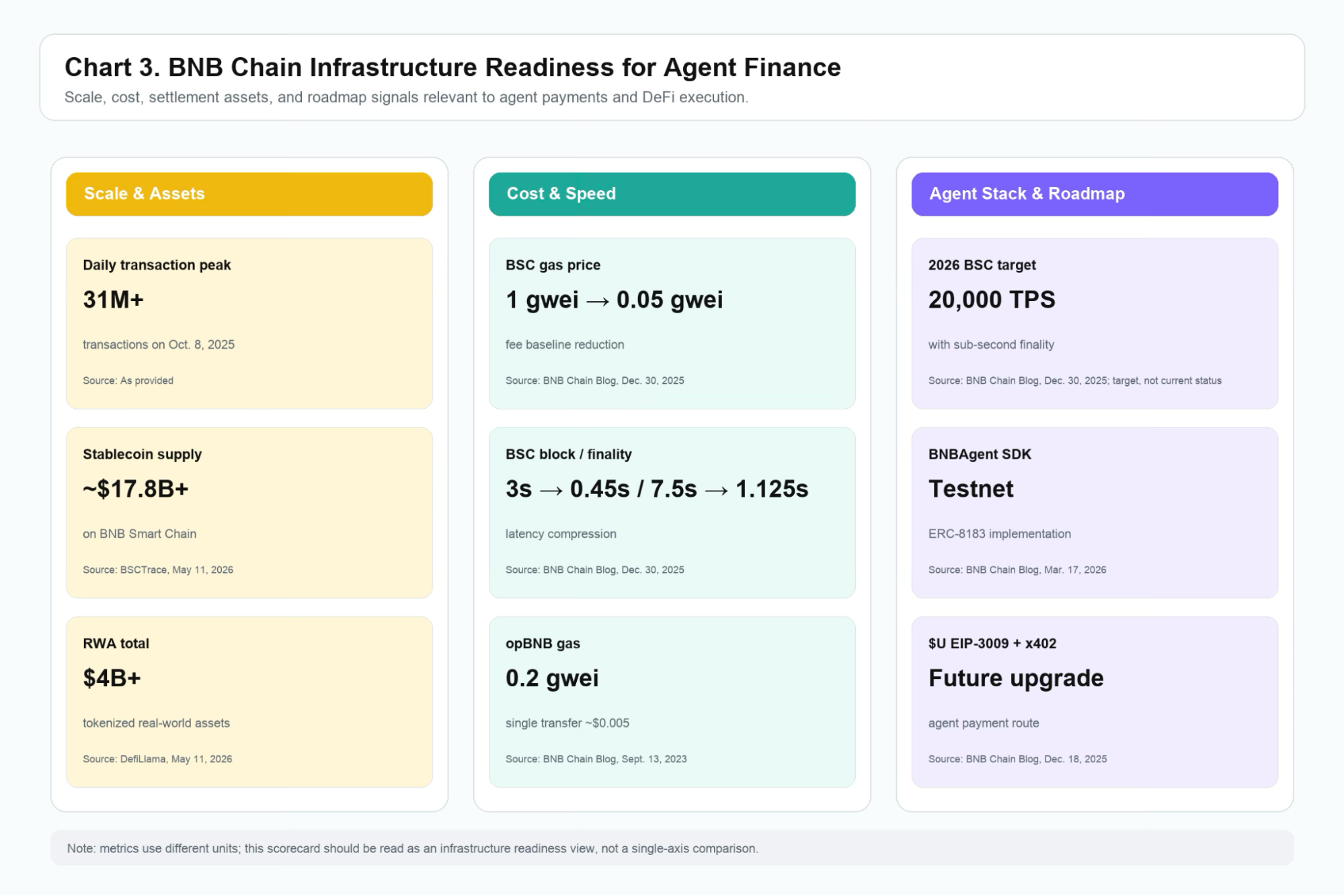
Figure 3. BNB Chain infrastructure readiness for agent finance.
The pieces, in more detail:
BNBAgent SDK bundles ERC-8004 identity, the ERC-8183 task lifecycle, escrow, and UMA arbitration into a Python toolkit. It puts identity, tasks, fund custody, and dispute handling behind one set of composable interfaces. That covers identity, capability, and accountability in a single SDK.
The $U and stablecoin layer covers payment and settlement. Agents have different payment needs from human users: small payments, frequent settlement, programmable authorization, and the ability to tie payment to task outcomes. $U is live as a native stablecoin on BNB Chain. If planned support for EIP-3009 and x402 delegated execution ships, the settlement model gets closer to what agent payments actually need.
BSC and opBNB cover execution cost. An agent generates far more onchain actions than a human user: queries, payments, confirmations, calls, adjustments, records. Gas cost, block time, and throughput determine whether high-frequency agent activity is practical at all.
The DeFi surface is where this becomes more than payments. Payments are the entry point. Agents eventually need to execute financial actions: swap, LP, staking, lending, repayment, yield routing, risk adjustment. PancakeSwap, Lista, and Venus are separate front ends for human users. For agents, they can be treated as callable financial modules.
Wallet-side tooling, including Trust Wallet Agent Kit, sits closer to user authorization. BNBAgent SDK answers how agents get onchain. Wallet tooling answers how users authorize what those agents can do.
The gaps. The delegated-execution payment path (EIP-3009, x402) is on the roadmap rather than in production today. Reputation primitives exist via ERC-8004 registration, but cross-protocol reputation portability is still early. Most application activity remains in the qualitative-signal category: named projects rather than at-scale onchain volume tied to discrete agent tasks.
5. What comes next
The next phase of BNBAgent SDK is planned to extend storage of agent identity, reputation, task records, and key states on BSC. BNB Greenfield is positioned as a longer-term data and memory layer for more persistent onchain agents. Timing and exact scope are not finalized publicly.
BNB AI Studio is intended to extend the surface further by simplifying agent creation, vibe coding, onchain deployment, payment, and data storage. The aim is a BNB Chain-native environment for building and running AI agents. This is roadmap framing, not a current release.
Conclusion
The inflection point comes when AI agents start behaving like economic participants. They call services, buy data, pay for compute, execute financial actions, and leave traces when something goes wrong.
That changes what a blockchain is for. It stops being only a venue for asset issuance and trading. It also becomes a record layer, a settlement layer, and an execution layer for agent activity.
BNB Chain carries several of the needed conditions at once: agent identity, stablecoin payments, low-cost execution, DeFi surfaces, and task accountability. Based on public information, these still need more mainnet data and production evidence. The direction is visible. The data is partial.
The next question is not how many AI projects connect to BNB Chain. It is how many agents can complete a real task loop on BNB Chain: receive authorization, pay for a service, call a protocol, deliver a result, and leave a verifiable record.
The agent economy is not, at its core, a model problem. It is an economic infrastructure problem.
Disclaimer
This article is for informational and ecosystem research purposes only. It does not constitute investment, legal, or financial advice. References to third-party projects, market data, and external platforms are based on publicly available information, and such data may change over time. Readers should assess their own risk and comply with the applicable laws and regulations of their jurisdiction before participating in any onchain application, AI agent application, or digital asset related activity.
References
- BNB Chain Blog: BNB Chain is the #1 Network for AI Agents
- BNB Chain Blog: BNBAgent SDK
- BNB Chain Blog: United Stables $U
- BNB Chain Blog: Tech Roadmap 2026
- Google Cloud: Agent Payments Protocol (AP2)
- PayPal Developer: Agent Payments Protocol
- PayPal Agent Ready Docs
- Anthropic: Model Context Protocol
- 8004scan Networks
- NfaSCAN