Chains
BNB Beacon Chain
BNB ecosystem’s staking & governance layer
Staking
Earn rewards by securing the network
Build
Explore
Accelerate
Connect
BNB Chain Market Making Landscape: Liquidity Venues & How to Integrate

TLDR
- BNB Chain runs RFQ, proprietary AMM, and permissionless AMM venues side by side across every asset class that trades on the chain, so a market maker can plug in at whichever layer fits its model.
- More than $19B of bStocks have been traded since launch across those venues, with 67+ assets active and over $500M in AUM.
- Builders can reach every venue through one aggregator API, or integrate venues directly for tighter control.
- Market makers can quote through a shared credit pool, an RFQ desk, or their own deployed prop AMM.
BNB Chain supports every major market-making model at once: RFQ desks, proprietary AMMs backed by dedicated makers, and permissionless AMM pools anyone can provide liquidity into. Together these venues move well over $10B a day, across every asset class that trades on the chain.
Below is who they are, how they price, and what it takes to connect as a wallet, an aggregator, or a market maker
Market-Making Landscape
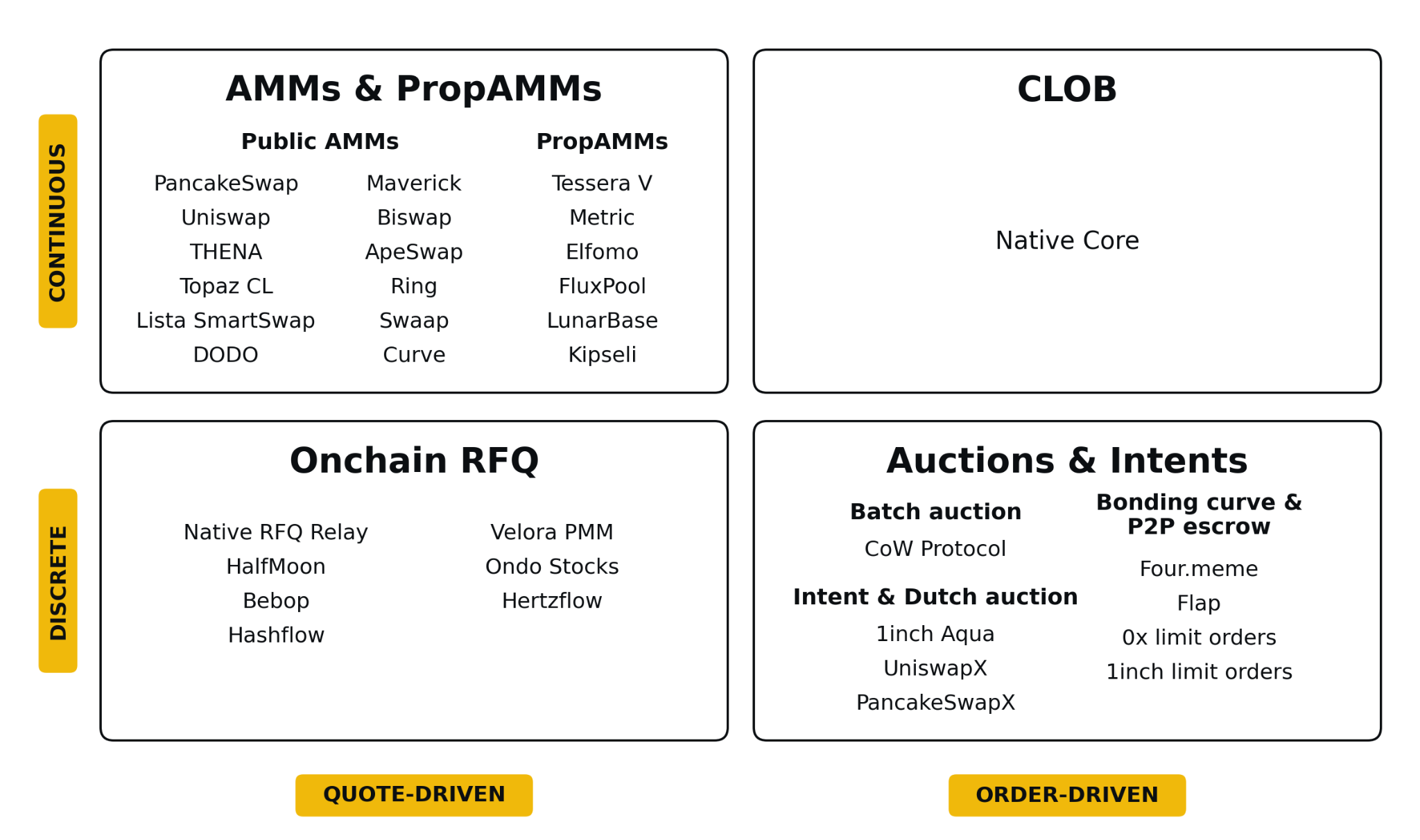
RFQs and PropAMMs
1inch Aqua
1inch Aqua is 1inch's intent-based settlement layer, replacing the now-inactive Fusion: independent resolvers compete in a Dutch auction to fill a taker's order as the price decays
Bebop
Bebop is an RFQ protocol that settles EIP-712-signed maker orders through its settlement contract. with makers pricing from their own onchain inventory across a broad basket of BSC assets.
CoW Protocol
CoW Protocol runs a batch auction rather than continuous trading. Orders are collected into batches and independent solvers compete for the right to settle each batch, first netting any coincidence of wants directly between users before touching an AMM or an RFQ maker at all. That makes it a fourth mechanism alongside AMMs, RFQ, and order books.
Elfomo
Elfomo operates a smaller proprietary AMM, where pricing is set by a curator/vault model layered on oracle inputs. It covers fewer tickers, and its value to builders is as an independent onchain quote to compare against larger venues.
FluxPool
Fluxpool is a PropAMM that trades primarily major cryptocurrencies alongside several long-tail token pairs.
Kipseli
Kipseli is a PropAMM run by Kipseli Capital that uses a signed quote model where a taker requests a quote, gets a signed price back, and settles onchain against it.
LunarBase
LunarBase runs a PropAMM priced by a rotating quorum of operator wallets reading multiple CEX venues, live on BSC with BNB/USDT and BTCB/USDT pools.
Metric
Metric built new pool architecture that prices against a live reference. The liquidity moves in deviation bands with that price, keeping it concentrated where the market actually trades. That concentration drives Metric’s high capital efficiency, allowing small inventory to serve large trade sizes and high volume.
Native
Native combines RFQ execution with an onchain central limit order book and a shared liquidity pool. Market makers draw inventory from the pool and quote through Native Relay. Native also issues public liquidity positions via NativeLPToken and WrappedNLP.
Ondo Stocks
Ondo Stocks is an issuance and redemption platform for tokenized publicly traded U.S. stocks and ETFs. It enables investors outside the United States to gain economic exposure to these assets by minting, transferring, and redeeming securities-backed tokens. Each token is fully backed by the corresponding stock or ETF (together with cash in transit).
PancakeSwapX
PancakeSwapX is PancakeSwap's intent-based execution layer, using Dutch-auction fills rather than a public pool.
Tessera
Tessera is a PropAMM operated by Wintermute. Applications request onchain quotes, and Wintermute's pricing engine sets the rate from external prices, trade size, and inventory risk.
UniswapX
UniswapX is Uniswap’s intent-based execution layer: a taker signs an order and independent fillers compete in a Dutch auction to fill it, rather than routing through a public pool
AMMs
DODO
DODO uses a Proactive Market Maker (PMM) model instead of a constant-product curve: it reads external price oracles and concentrates liquidity around the live market price, which lets it support single-asset liquidity provision and tighter pricing near the mid for the pairs it covers.
Lista SmartSwap
Lista SmartSwap is Lista DAO's own DEX, focused on a small set of closely correlated pairs (like slisBNB/BNB) where liquidity doubles as collateral for Lista's lending product. Coverage is narrow by design, so it matters mainly for LST-adjacent routing rather than general asset coverage.
Maverick
Maverick runs a dynamic-distribution AMM in which liquidity can be configured to follow the price as it moves rather than sitting in a static range, which reduces how often a liquidity provider has to rebalance in a trending market.
PancakeSwap
PancakeSwap is the largest DEX on BNB Chain and uses a standard AMM model. Its bStocks liquidity concentrates in high-volume assets including QQQB, SPCXB, SPYB, and NVDAB, so check that a pool holds enough depth for your size before routing to it.
THENA
THENA is a ve(3,3)-style DEX on BNB Chain, combining volatile and stable-pair pools with a vote-escrow token that directs weekly emissions to liquidity gauges.
Topaz CL
Topaz is a ve(3,3) DEX on BNB Chain running both classic v2-style pools and a concentrated-liquidity engine (Slipstream) for tighter pricing on specific price ranges.
Uniswap
Uniswap also uses the fundamental AMM design, with most of the bStocks volume now driven by the reactivation of more than 100 low-fee Uniswap v4 pools tied to QQQB incentives.
How Liquidity Reaches Users
How Wallets and Apps Connect
Aggregators give users and wallets access to several liquidity sources through one interface, rather than a separate integration per venue.
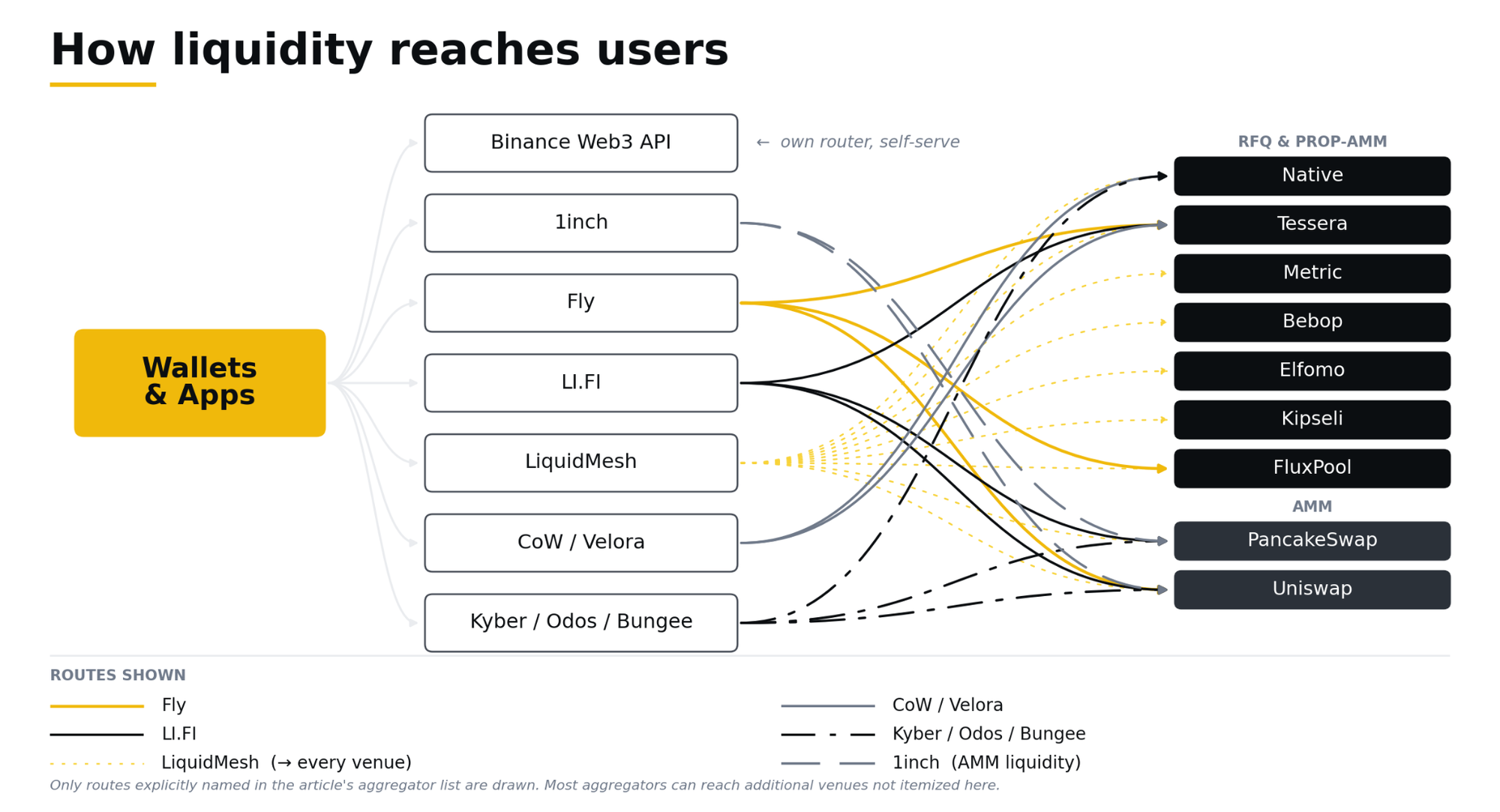
Binance Web3 Trading API
Binance Web3 Wallet runs its own cross-DEX aggregator and RFQ router, the Binance Web3 Trading API, available to any wallet or app through a self-serve developer portal. This is free to integrate with no per-request fee.
The core flow is as such: GET /quote → GET /swap → sign → broadcast (or sign the RFQ typed-data and POST /order/submit, then poll /order/{orderId})
This supports an optional onchain referral/platform fee (up to 5% on EVM) for integrators who want to take a cut of routed swaps. One constraint is that bStock RFQ quotes can be unavailable outside US market hours.
Get a self-serve API key here and read the full docs here.
How RFQ Platforms Onboard Market Makers
Getting listed on an RFQ panel is a technical integration plus a commercial one. In broad terms, a maker needs:
- A quoting endpoint that returns a signed, executable price within the aggregator's latency budget. Aggregators drop makers that time out, so the latency target matters more than the theoretical best price.
- Inventory to back the quote, either the maker's own book or capital drawn from a shared pool.
- A settlement path the aggregator already supports, most commonly EIP-712-signed orders through the maker's or the venue's settlement contract.
- Commercial and compliance sign-off, including KYB where the aggregator or the tokenized-asset issuer requires it. bStocks carry transfer and pause controls at the token level, so a maker also needs to handle compliance-driven transfer failures rather than assuming a valid balance means a valid transfer.
How Market Makers Get More Volume
Integration gets you into the auction and routing share comes from how you perform in it. Generally, aggregators allocate more trading volume to market makers who effectively provide competitive bids and ask quotes. Other factors include:
- Price at the sizes that actually flow. Aggregators route per order, so winning the $500 to $5,000 band on a high-volume ticker is worth more than a good quote at a size nobody trades.
- Quote reliability, where a maker that quotes tight and then rejects or fails to settle gets deprioritised.
- Response latency, since a late quote is not in the comparison at all.
- Ticker coverage, because a maker that prices only the top four names competes for a narrow slice of flow.