Chains
BNB Beacon Chain
BNB ecosystem’s staking & governance layer
Staking
Earn rewards by securing the network
Build
Explore
Accelerate
Connect
Careers🔥
Explore Opportunities on BNB Chain
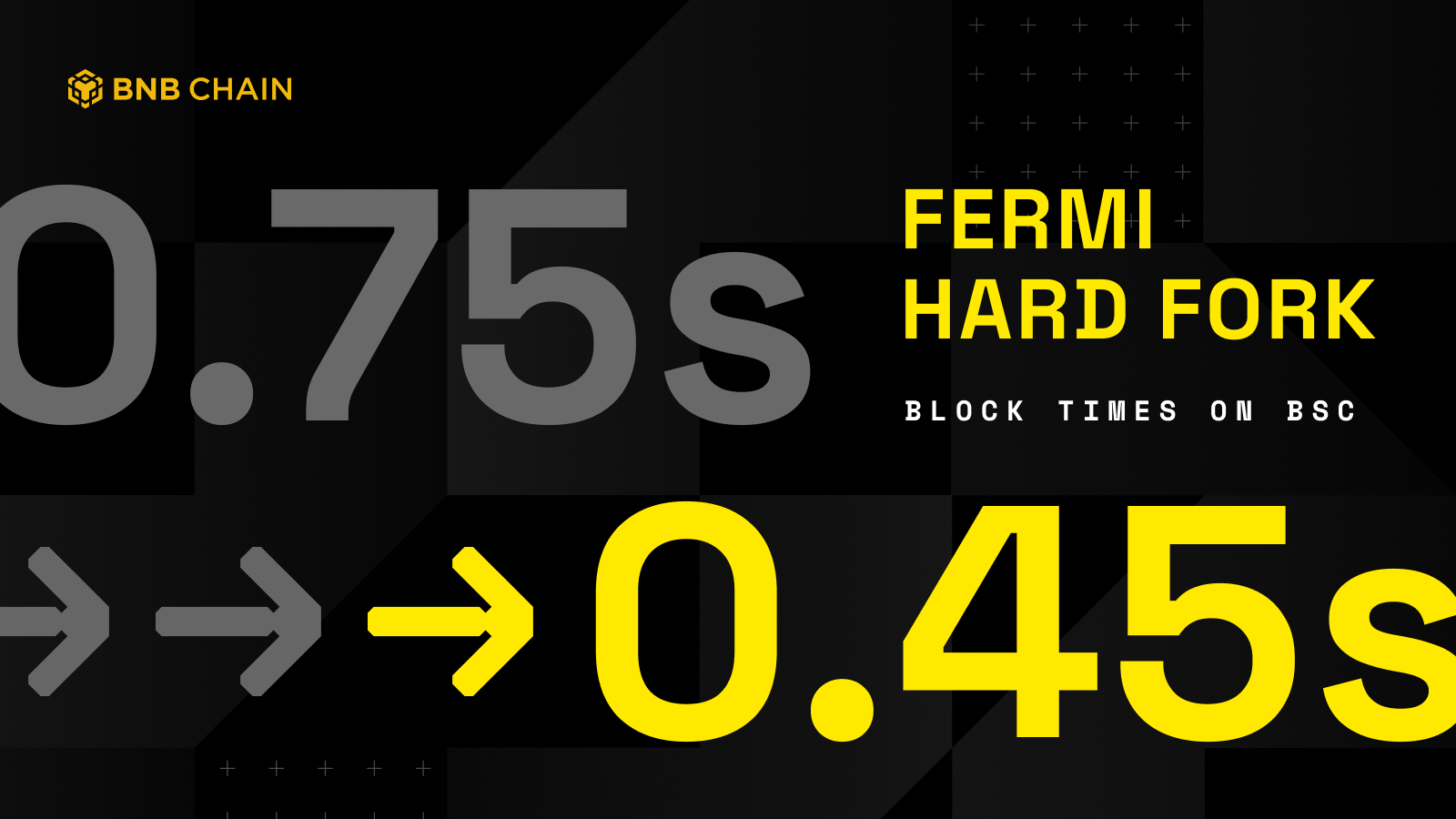
Fermi Hard Fork Accelerates BSC to 0.45-Second Block Times
TL;DR
- The Fermi hard fork is scheduled to activate on BSC mainnet on January 14, 2026 at 02:30 UTC, supported by the v1.6.4 client release.
- Fermi reduces block time from 0.75 seconds to 0.45 seconds and strengthens fast finality rules, improving responsiveness while keeping the network stable under load.
- Validators and node operators must upgrade to v1.6.4 or later versions before activation. Snapshot regeneration and log indexing will run on first startup.
BNB Chain continues to advance the performance of BNB Smart Chain (BSC). Following the Pascal and Maxwell upgrades, the network is preparing for its next protocol milestone: the Fermi hard fork.
Fermi focuses on making BSC faster in a way that remains predictable and reliable as network usage grows. The upgrade shortens block times, strengthens finality at higher throughput, and ensures the chain continues to perform consistently under real production conditions.
Fermi completes the multi-phase short block interval roadmap, bringing BSC to its fastest block times to date and pushing the network closer to the physical limits of global block propagation.
The Fermi hard fork is delivered through the BSC v1.6.4 client, with v1.6.5 provided as a follow-up synchronized maintenance release.
What is the Fermi Hard Fork?
The Fermi hard fork is the next performance upgrade for BNB Smart Chain (BSC), following the Lorentz, Pascal and Maxwell upgrades. Its purpose is straightforward: make the network faster without compromising reliability.
BSC has already demonstrated that it can operate at scale across DeFi, gaming, payments, and consumer applications. As usage continues to grow, improving day-to-day responsiveness becomes just as important as raw capacity. Fermi focuses on tightening block production and finality so the network remains predictable, even as blocks are produced more frequently.
For users, this means quicker confirmations and smoother interactions.
For developers, it means lower latency and more responsive applications.
For operators, it means maintaining stability while the chain runs faster.
These improvements are particularly important for high-frequency DeFi, advanced trading strategies, and applications that depend on fast and consistent onchain settlement.
What Changes with Fermi?
The Fermi hard fork includes the following BEPs:
- BEP-590: Extended Voting Rules for Fast Finality Stability
- BEP-619: Short Block Interval Phase Three (0.45 seconds)
- BEP-592: Non-Consensus Based Block-Level Access List
- BEP-593: Incremental Snapshot
- BEP-610: Implement EVM Super Instruction
Shorter Block Times
Fermi advances BSC’s short block interval roadmap by reducing the block interval from 0.75 seconds to 0.45 seconds.
This change delivers practical benefits:
- Transactions are included in blocks more quickly
- Confirmation times are reduced
- Applications feel more responsive during periods of high activity
Shorter block times improve user experience across wallets, dApps, and infrastructure, especially for applications that rely on fast feedback from the chain.
Stronger Fast Finality at Higher Throughput
Producing blocks more frequently increases pressure on consensus. To support this, Fermi introduces updated voting rules for fast finality through BEP-590.
Fast finality allows transactions to be confirmed with high confidence within a small number of blocks, reducing the time users and applications need to wait before treating a transaction as irreversible. With Fermi, fast finality remains a recommended and reliable confirmation mechanism, even as block times shorten and throughput increases
These updates help:
- Maintain reliable finality as block frequency increases
- Reduce the risk of finality delays during congestion
- Keep confirmation guarantees consistent for applications
Together, these changes allow BSC to move faster while preserving the security assumptions developers and users rely on.
How Fermi Fits Into the 2026 Roadmap
Fermi is part of BNB Chain’s broader focus on sustained execution quality, not just peak performance.
As outlined in the BNB Chain Tech Roadmap 2026, the network is moving toward:
- Faster execution under real production load
- Predictable performance for applications
- Infrastructure that scales without increasing operational complexity
By combining shorter block times with stronger finality safeguards, Fermi lays the groundwork for future upgrades planned across 2026.
What’s Required From Ecosystem Participants
Validators and Node Operators
- Upgrade all BSC mainnet nodes to v1.6.4 before 2026-01-14 02:30 UTC
- Plan for snapshot regeneration and log indexing on first startup
- Monitor node performance during and after the upgrade
Faster block production also introduces tighter timing requirements for validator infrastructure, particularly around networking, disk I/O, and block propagation performance.
Developers and Infrastructure Providers
- No contract changes are required for compatibility
- Be aware of faster block times when monitoring confirmations or building time-sensitive applications
- Review finality assumptions if your application relies on confirmation timing
Teams relying on polling-based transaction monitoring or fixed timing assumptions should review event handling and confirmation logic, as faster block production may affect existing workflows.
Important Follow-Up Notes
Snapshot Regeneration
After upgrading to v1.6.4, nodes will trigger snapshot regeneration. During this process, node performance may be temporarily reduced.
On BNB Chain’s reference hardware, snapshot regeneration took approximately 5 hours. Operators should plan maintenance windows accordingly.
This process is part of the transition toward incremental snapshot handling, which improves long-term node performance and reduces operational overhead.
Log Indexing
The v1.6.x series introduces a new log indexing mechanism.
For v1.6.4, indexing starts from block 59,484,738 and can consume noticeable CPU resources during startup. If full historical log indexing is not required, operators can limit indexing to recent data using:
--history.logs 600000
This limits indexing to roughly the last three days.
Looking Ahead
Each BNB Chain hard fork reflects lessons learned from operating the network at real scale. Fermi represents a shift toward refining everyday performance, ensuring speed improvements come with the stability developers and users expect.
More upgrades will follow as BNB Chain continues executing on its 2026 roadmap and supporting the next phase of onchain growth.