Chains
BNB Beacon Chain
BNB ecosystem’s staking & governance layer
Staking
Earn rewards by securing the network
Build
Explore
Accelerate
Connect
How BSC Achieved Sub-Second Finality: A 70x Leap from 45s to 0.65s
TL;DR
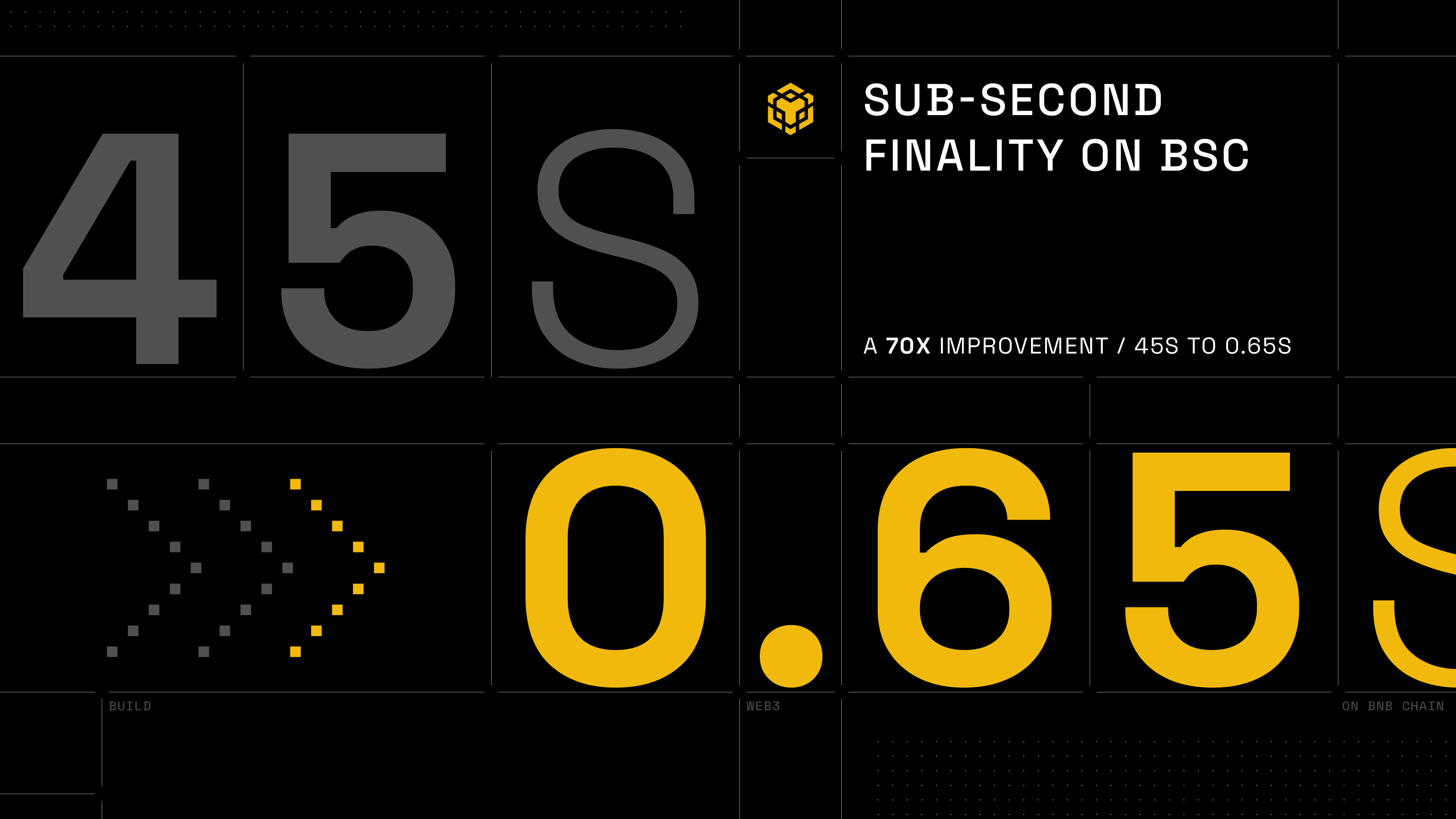
- BNB Smart Chain (BSC) now finalizes blocks in ~0.65 seconds, down from ~45 seconds in 2022, a 70x improvement
- A layered consensus architecture, where block production separates from finality, is what made this possible without sacrificing liveness
- Four BEPs: 126, 590, 648, and 667, each removed one specific bottleneck the previous one exposed
- BEP-648, which shipped with the Osaka/Mendel hard fork in April 2026, is what pushed finality below one second
When a block is final, it cannot be reversed: Any user, bridge, or exchange can act on it immediately. Before 2022, reaching that certainty took BNB Smart Chain (BSC) about 45s.
Today it takes 0.65s, a nearly 70x improvement built through four years of deliberate and sequenced protocol work.
That gap matters, as sub-second finality is the difference between infrastructure that supports real financial activity and infrastructure that merely approximates it. Here's how BSC reaches sub-second finality.
The Architecture Choice That Made 0.65s Possible
Before any upgrade could happen, BSC needed the right foundation. The key design choice was keeping block production and finality as separate concerns. A dedicated finality layer sits on top of Parlia, BSC's base consensus mechanism, adding cryptographic certainty through validator votes without touching block liveness.
If finality hits trouble, blocks can continue to flow. That failure profile, degradation instead of a halt, is what made iterating on finality possible without risking chain uptime. It's also what gave the protocol room to improve, one targeted upgrade at a time.
The Starting Point: Parlia and the 45s ceiling
The base consensus layer of BSC, Parlia, a Proof-of-Staked-Authority variant, was built to keep the chain alive and it does that well. What it didn't provide was cryptographic finality. Without a formal finality mechanism, you needed 15 block confirmations at 3s intervals before a transaction was practically irreversible, roughly ~45s.
For a growing ecosystem of DeFi protocols, bridges, and onchain applications on BSC, that was a real constraint.
The Path to 0.65s: Four Upgrades, One Direction
BEP-126: The Finality Layer
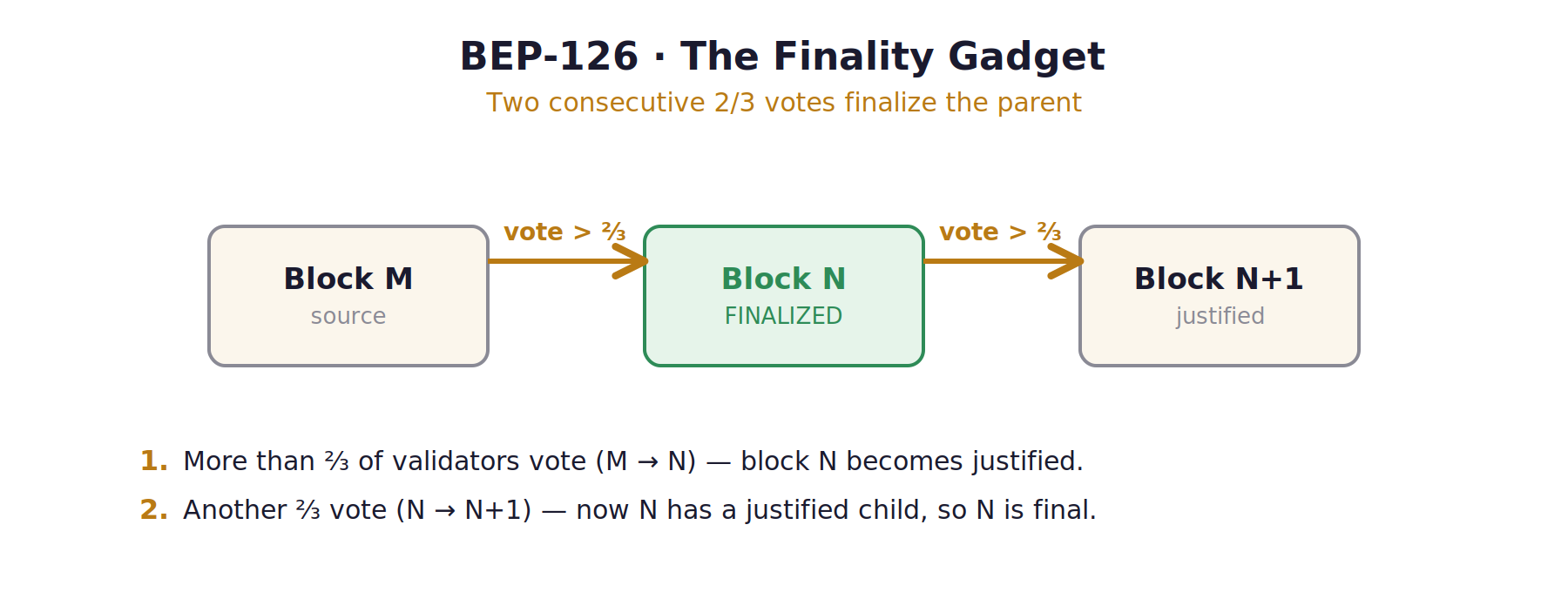
BEP-126 in 2022 introduced the finality layer: a BLS-signature voting mechanism where consecutive blocks collecting two-thirds validator votes cause the first to finalize cryptographically.
The results? Finality dropped to roughly ~2-3s and the foundation was in place.
BEP-590: Extended Voting Rules for Fast Finality Stability
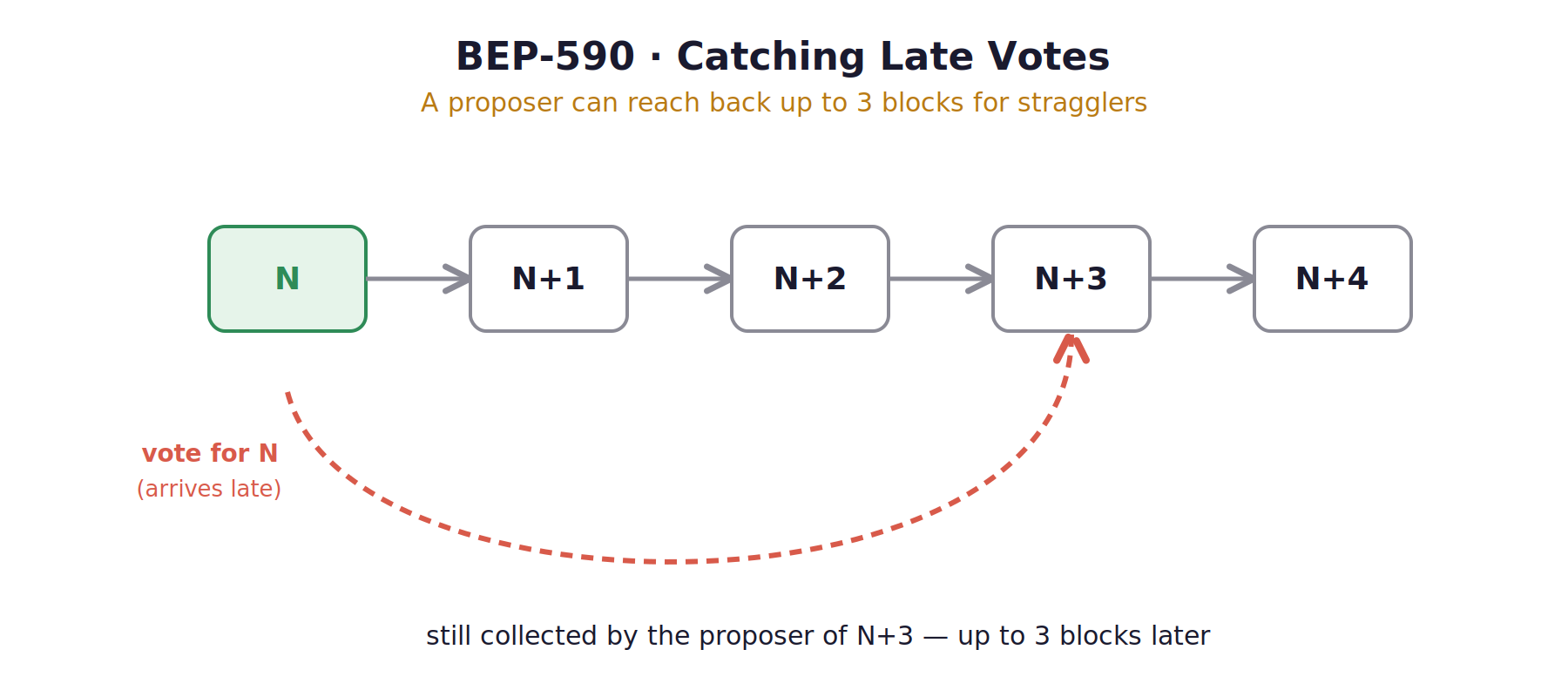
BEP-590 addressed instability that emerged as block times shortened to 0.45s through the Lorentz, Maxwell, and Fermi hard forks. Votes arriving slightly late were getting dropped, creating gaps in the finality chain. Extending the vote collection window to cover recent ancestor blocks absorbed the jitter and restored steady finality at faster block times.
At a 0.45s block interval, fast finality came back to a steady rhythm with average finality around two block intervals, roughly ~0.9s.
BEP-648: Enhanced Fast Finality via In-Memory Voting Pool
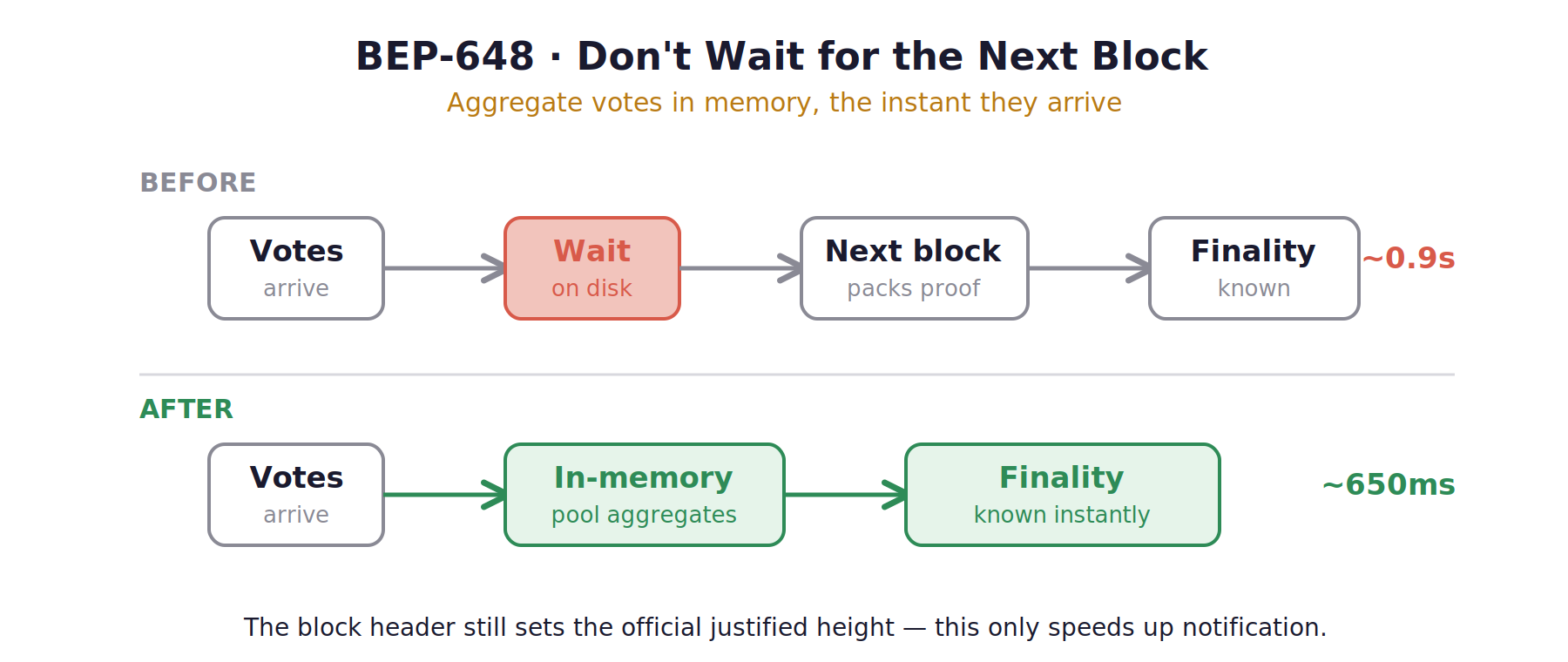
In April 2026, BEP-648 was implemented with the Osaka/Mendel hard fork to close the last major gap. Finality confirmation was still coupled to block production and votes had to wait for the next proposer to package them. An in-memory vote pool changed that, allowing votes to aggregate in real time. The moment a two-thirds quorum lands, finality is known.
This was the upgrade that made sub-second settlement a production reality: from ~0.9s to ~0.65s.
BEP-667: Vote Interval to Relax Fast Finality Constraints
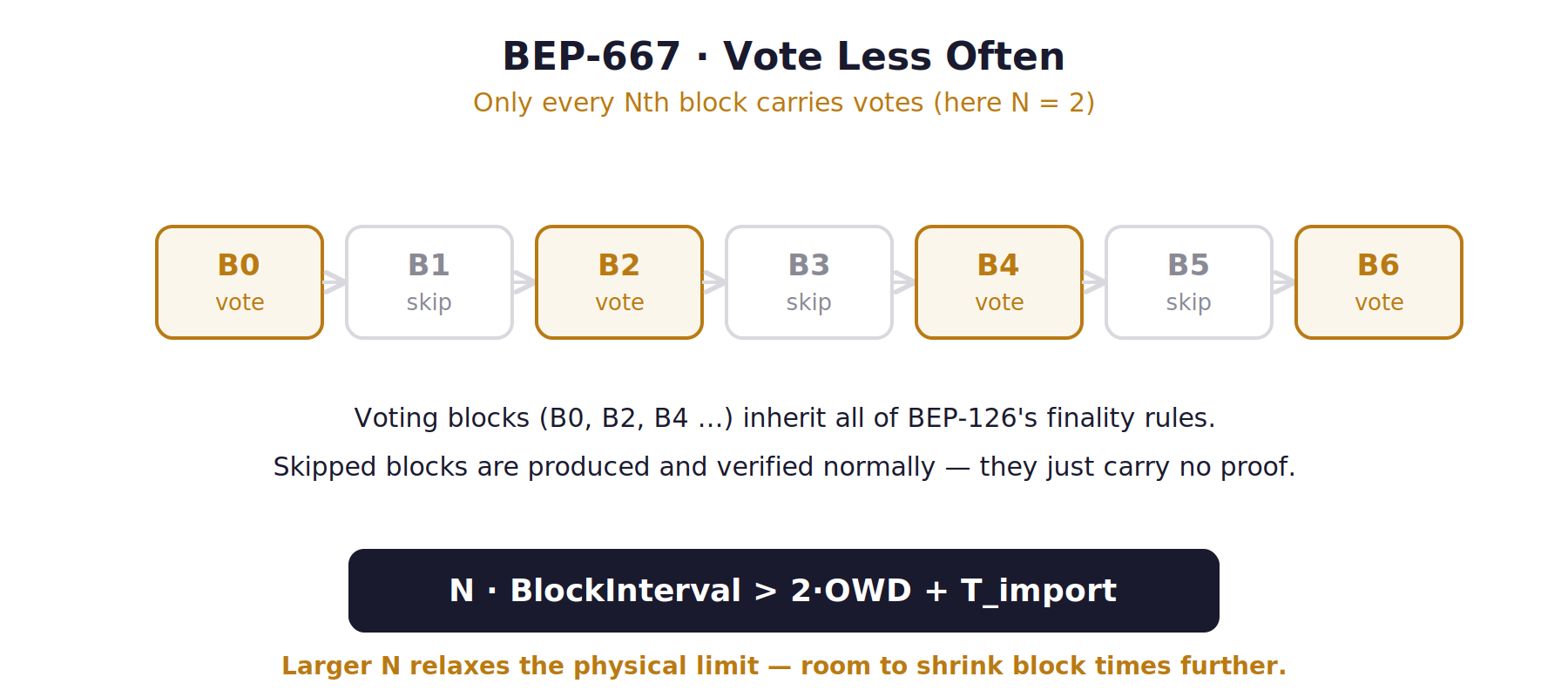
BEP-667 was the infrastructure for what came next. As block intervals approach 250ms, vote propagation starts consuming the entire block window. Validators now vote every Nth block rather than every block, keeping overhead proportional as block times continue to compress.
What Sub-Second Finality Unlocks for the BSC Ecosystem
Today, 0.65s finality is in production on mainnet and changes what's possible on BSC:
- Bridge relayers can confirm cross-chain transfers in under a second
- Exchanges can credit deposits almost instantly
- DeFi protocols, prediction markets, and payment applications can run on settlement certainty that previously required centralized infrastructure
No changes to the EVM environment means every existing application on BSC gets this automatically, with nothing to migrate or deploy.
From 45s to 0.65s, this is what incremental and intentional protocol design looks like when it works.
Learn more about the full BEP specifications on BNB Chain GitHub.